
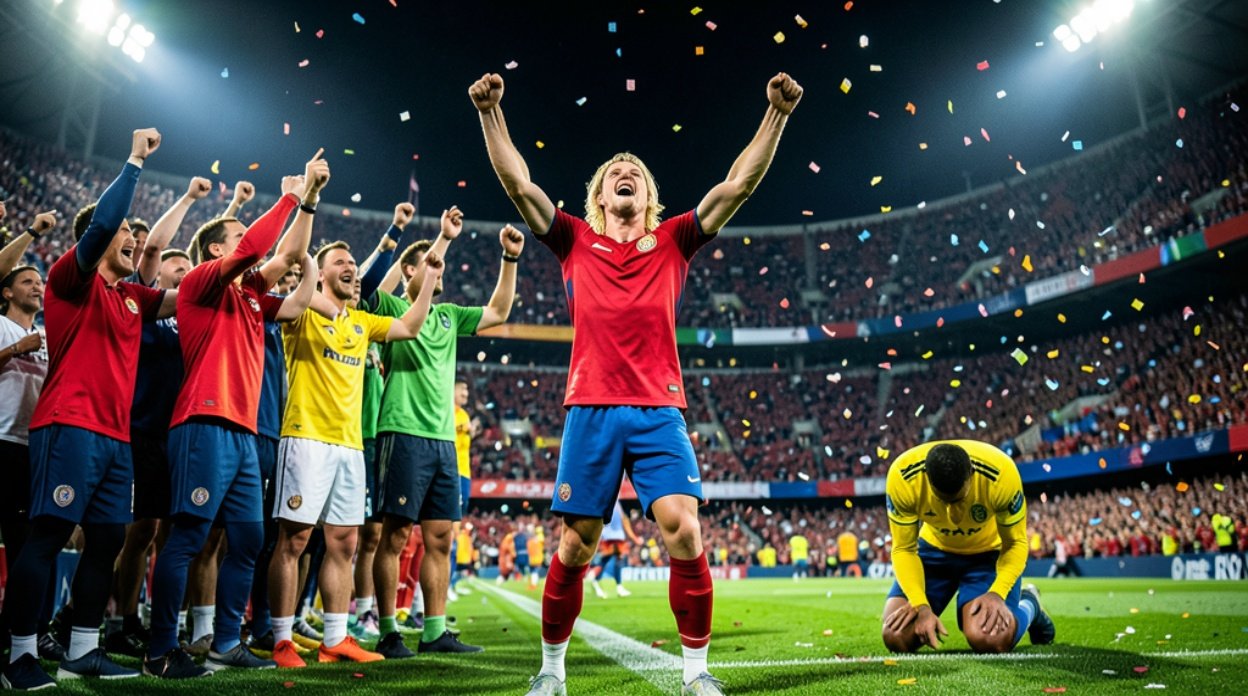
Haaland Shocks Brazil Major Tournament Upset: A Tactical Masterclass Ends Neymar’s Dream
The annals of football history are replete with tales of the unexpected, moments when David slays Goliath, and established powerhouses tumble against seemingly insurmountable odds. Yet, few anticipated the seismic shockwave that reverberated across the global football landscape when the Nordic powerhouse, spearheaded by the relentless Erling Haaland, delivered a performance for the ages, culminating in the stunning elimination of Brazil, the venerable Samba Kings, from a prestigious international challenge. This wasn’t merely a defeat; it was a brutal shattering of expectations, a tactical dismantling, and for Brazil’s talismanic captain, Neymar, a heartbreaking end to a deeply cherished ambition on the grandest stage.
The collective gasp of millions of fans worldwide underscored the magnitude of the event. Brazil, with its rich tapestry of footballing heritage and an unyielding expectation of victory, entered the knockout clash as overwhelming favorites. Their squad, brimming with world-class talent and propelled by the visionary flair of Neymar, seemed destined for the latter stages of the competition. But football, in its beautiful unpredictability, often writes scripts more dramatic than any fiction. This match served as a stark reminder that passion, strategy, and the sheer will of a generational talent can indeed redefine the narrative, leaving an indelible mark on the sport’s collective memory.
The Unforeseen Collision: Build-Up to a Legendary Encounter
Leading up to this quarter-final clash in the prestigious international challenge, the narrative was firmly centered on Brazil’s seemingly unstoppable march. Their group stage performances had been clinical, marked by moments of individual brilliance and cohesive team play that hinted at a side ready to claim ultimate glory. A Seleção possessed a squad depth that was the envy of many, with a formidable attacking trident, a creative midfield, and a robust defense.
Brazil’s Aura of Invincibility and Neymar’s Burden
For decades, Brazil has carried the weight of expectation with a blend of confidence and swagger. Their vibrant style of play, known globally as ‘Joga Bonito,’ promised entertainment and, more often than not, success. In this particular edition of the global competition, the Canarinhos had navigated their path with characteristic flair, dispatching opponents with a blend of skill and tactical discipline. The spotlight, as always, shone brightest on Neymar. The attacking maestro, now in what many considered his prime, was not just a player but the emotional heartbeat of the team. He bore the hopes of an entire nation on his shoulders, with every dribble, pass, and shot scrutinized for signs of the magic that could lead Brazil to triumph. His performances prior to this encounter had been stellar, silencing critics and galvanizing his teammates. The dream of leading his beloved nation to international glory was palpable, a narrative thread woven through every interview and training session.
The Nordic Lions: Underdogs with a Roar
In stark contrast stood the Nordic powerhouse. While they boasted individual talents, chief among them the phenomenon Erling Haaland, their collective pedigree on such a grand stage was not comparable to Brazil’s illustrious history. They were seen as dark horses, a team capable of causing an upset on their day, but few genuinely believed they could overcome the five-time champions elect. Their journey through the group stages had been admirable, characterized by a pragmatic approach, disciplined defending, and a reliance on Haaland’s prodigious goalscoring ability. They had demonstrated resilience and a growing tactical maturity, but against the Samba Kings, they were expected to be overwhelmed. The betting odds reflected this sentiment, painting a picture of a foregone conclusion. Yet, within the Nordic camp, a quiet confidence brewed, fueled by a belief in their system and the unparalleled predatory instincts of their star striker. They knew that to win, they would need to execute a flawless plan, capitalize on every opportunity, and contain Brazil’s creative genius.
The Battle Unfolds: First Half Dynamics and Tactical Chess
From the opening whistle, the atmosphere was electric. The roar of the crowd, a vibrant mix of yellow and blue against a sea of red and white, amplified the tension. Brazil started with their characteristic attacking verve, pushing high and attempting to assert their dominance through intricate passing sequences and individual trickery. Neymar was immediately involved, drifting between lines, demanding the ball, and attempting to unlock the Nordic defense with his trademark flicks and through balls.
Brazil’s Early Dominance and Nordic Resilience
The initial twenty minutes saw Brazil dictate the tempo, monopolizing possession and probing the Nordic defensive block. Wingers looked to stretch the play, while the full-backs bombed forward, creating numerical advantages in wide areas. There were flashes of brilliance: a dazzling dribble by Vinicius Júnior on the left flank, a powerful shot from Rodrygo that whistled just wide, and a free-kick from Neymar that forced a diving save from the Nordic goalkeeper. However, the Nordic defense, organized and disciplined, held firm. They operated in a compact 4-4-2 shape, suffocating Brazil’s creative midfielders and denying Neymar the space he craved. The two holding midfielders for the Nordic side were crucial, tirelessly tracking runners and breaking up play, acting as a vital shield for their back four. Each Brazilian attack was met with a resolute block or a timely interception, a testament to the meticulous preparation by the Nordic coaching staff. The physical commitment of the Nordic players was evident, as they threw themselves into challenges, refusing to be intimidated by the reputation of their illustrious opponents.
Haaland’s First Strike: A Glimmer of What Was to Come
Against the run of play, the Nordic powerhouse delivered a stunning counter-punch. A swift transition, initiated by a turnover in Brazil’s midfield, saw the ball quickly shifted wide to a rapidly advancing full-back. With a perfectly weighted cross, the ball soared into the penalty area. And there, like a beacon of raw power and precision, was Erling Haaland. Out-muscling a Brazilian center-back with deceptive ease, he rose majestically to meet the ball, heading it with immense force and accuracy past the outstretched arms of the Brazilian goalkeeper. The stadium erupted, a mix of shock and jubilation. It was a goal born from pure instinct, an embodiment of Haaland’s aerial prowess and his uncanny ability to be in the right place at the right time. The goal, coming in the 28th minute, completely altered the complexion of the game. Brazil, for the first time in the tournament, looked genuinely rattled. The Nordic team, buoyed by the unexpected lead, intensified their defensive efforts, making themselves even harder to break down. The goal was a psychological blow, forcing Brazil to reconsider their approach and injecting a potent dose of belief into the Nordic contingent.
Haaland’s Unstoppable Force: A Masterclass in Striking
Erling Haaland’s performance was not merely about goals; it was a comprehensive demonstration of everything that makes him one of the most feared strikers in modern football. His physical presence, relentless movement, and clinical finishing were on full display, tormenting the Brazilian defense from the first whistle to the last.
Power, Pace, and Precision: Haaland’s Dominance Defined
Haaland’s opening goal was just a prelude. Throughout the match, he was a constant menace, a physical and athletic nightmare for Brazil’s experienced central defenders. His ability to hold up the ball under immense pressure, drawing fouls and allowing his teammates to push up the field, was crucial. He used his explosive pace to burst past defenders, creating space for himself and disrupting Brazil’s defensive shape. But it was his predatory instinct in the box that truly set him apart. He possessed an almost telepathic understanding of where the ball would land, anticipating crosses and rebounds with alarming accuracy. His finishing, whether with his head or either foot, was consistently clinical, leaving goalkeepers with little chance. Each time the Nordic team ventured into Brazil’s half, a palpable sense of anxiety rippled through the Samba Kings’ backline, knowing that any lapse in concentration could be met with Haaland’s ruthless efficiency. He wasn’t just scoring; he was dictating the terms of engagement in the final third, forcing Brazil’s defense to constantly adapt and often fail.
The Decisive Blow: Haaland’s Second and Brazil’s Despair
As Brazil desperately pushed for an equalizer in the second half, committing more players forward and leaving gaps at the back, Haaland delivered the fatal blow. In the 65th minute, a perfectly executed long pass from the Nordic midfield bypassed Brazil’s high defensive line. Haaland, timing his run to perfection, burst through, leaving two Brazilian defenders in his wake. With only the goalkeeper to beat, he displayed remarkable composure, slotting the ball precisely into the bottom corner with his left foot. It was a goal that encapsulated his brilliance: raw speed, intelligent movement, and ice-cold finishing. The celebration was understated but firm, a clear statement of intent. This second goal was a dagger to the heart of Brazil’s aspirations. It not only doubled the Nordic lead but also crushed the spirit of the Brazilian players, who had poured their hearts and souls into finding a way back into the game. The psychological impact was immense, transforming hope into despair for the Brazilian faithful and solidifying the Nordic team’s improbable lead.
Neymar’s Frustration: A Dream Unravels
While Haaland was ascendant, Neymar’s night was a stark contrast. He fought valiantly, displaying flashes of his undeniable genius, but ultimately, he was thwarted by a combination of resolute defending, strategic brilliance from the opposition, and perhaps, the immense pressure of a nation’s hopes.
The Weight of Expectation and The Tightening Net
From the outset, it was clear that the Nordic strategy revolved around neutralizing Neymar. He was consistently double-teamed, sometimes even triple-teamed, whenever he received the ball in dangerous areas. The Nordic defenders executed their plan with meticulous precision, denying him space to dribble, forcing him to play backward or sideways, and preventing him from dictating the attacking rhythm. Every time he attempted a signature move, a defender was there to dispossess him or force him into an error. The frustration was evident in his body language; the usual joy and freedom of his play were replaced by visible exasperation. He tried everything – dropping deep to collect the ball, drifting wide, attempting intricate one-twos – but the Nordic net around him was simply too tight. The physical toll of constantly battling for space and possession began to show, sapping his energy and impacting his decision-making in crucial moments. The pressure to be the savior of the Samba Kings was immense, and in this match, it seemed to weigh heavier than ever before.
Unanswered Calls and Fading Hope
Despite the relentless defensive attention, Neymar still managed to conjure moments of magic. A curling shot that grazed the post, a sublime pass that almost put a teammate through on goal, and several dazzling dribbles that momentarily bamboozled defenders were reminders of his quality. However, these individual flashes were not enough to break the Nordic resolve. His teammates, perhaps also feeling the pressure, struggled to convert the half-chances he created or to provide the consistent support needed to overwhelm the organized Nordic defense. As the clock ticked down and Haaland’s second goal solidified the Nordic lead, the despair on Neymar’s face became increasingly pronounced. His shoulders slumped, his usual effervescent spirit visibly dimmed. The dream of lifting the prestigious trophy, a dream he had openly spoken about and worked tirelessly for, was slowly but surely slipping away. The final whistle brought with it not just defeat, but the crushing realization that his journey in this global spectacle had come to an abrupt and agonizing end.
Tactical Masterclass: How the Nordic Powerhouse Outmaneuvered Brazil
The Nordic victory was not a fluke; it was the result of a meticulously crafted tactical plan executed with unwavering discipline and belief. The coaching staff of the Nordic powerhouse devised a strategy that played to their strengths while expertly exploiting Brazil’s potential weaknesses.
Defensive Solidity and Counter-Attacking Prowess
The cornerstone of the Nordic tactical approach was an unyielding defensive block. They deployed a deep-lying 4-4-2 formation, which morphed into a 4-5-1 when Brazil had prolonged possession, effectively denying space between the lines. The two central midfielders were tasked with screening the defense, preventing Brazil’s creative players from operating freely in dangerous zones. Full-backs maintained a disciplined position, rarely venturing too far forward, ensuring defensive solidity against Brazil’s wide attackers. This compact shape forced Brazil to play wide or attempt speculative long-range efforts, neither of which truly tested the Nordic goalkeeper. Crucially, their defensive solidity was paired with a devastating counter-attacking threat. Once possession was regained, the ball was quickly released to the wings or directly to Haaland, who would burst forward with incredible speed and power. The transitions were swift and incisive, catching Brazil’s often-advanced full-backs and midfielders out of position. This dual approach – impenetrable defense and lightning-fast attack – proved to be the perfect antidote to Brazil’s free-flowing style.
Exploiting Brazil’s High Line and Midfield Gaps
Brazil’s tactical setup, while designed for attacking fluidity, often left them vulnerable to quick transitions. Their full-backs were encouraged to push high, and their central midfielders, while technically gifted, sometimes left gaps in front of the defense when pressing. The Nordic coaching staff identified these areas as prime targets. They instructed their wide players to track back diligently but to be ready to spring forward instantly upon winning possession. The long passes to Haaland were not random; they were calculated attempts to exploit the space left behind Brazil’s high defensive line. Haaland’s exceptional off-the-ball movement and ability to beat the offside trap were key to this strategy. Furthermore, the Nordic team pressed strategically in midfield, targeting specific Brazilian players who were prone to dwelling on the ball, forcing turnovers in dangerous areas. These turnovers then quickly became opportunities for direct attacks, bypassing Brazil’s usually robust midfield screen and putting immediate pressure on their central defenders. It was a masterclass in risk-reward analysis, where the Nordic team knew precisely when to absorb pressure and when to unleash their offensive weapons.
Brazil’s Downfall: What Went Wrong for the Samba Kings
The defeat was a bitter pill for Brazil, prompting a period of intense introspection. While the Nordic powerhouse executed their plan flawlessly, several factors contributed to Brazil’s unexpected exit from the global competition.
Defensive Lapses and Lack of Clinical Finishing
Despite their reputation for defensive stability, Brazil’s backline showed uncharacteristic vulnerability in crucial moments. Both of Haaland’s goals stemmed from situations where individual marking was insufficient or where defensive organization broke down under pressure. The first goal, a header from a cross, highlighted a failure to adequately deal with Haaland’s aerial threat, while the second exposed their high line to his blistering pace. These were not isolated incidents but rather critical errors that cost them dearly. Compounding these defensive issues was a surprising lack of clinical finishing from Brazil’s usually prolific attackers. They created numerous chances, particularly in the first half and during their second-half resurgence, but time and again, shots either went wide, were saved by the Nordic goalkeeper, or were blocked by desperate defenders. Neymar, Vinicius Júnior, and Rodrygo all had opportunities that, on another day, might have found the back of the net. The inability to convert these chances into goals allowed the Nordic team to maintain their lead and absorb pressure, ultimately frustrating Brazil’s attacking endeavors.
Tactical Rigidity and Inability to Adapt
Brazil’s coach, while generally lauded for their tactical acumen, appeared to struggle to adapt to the Nordic team’s disciplined approach. The initial game plan, focused on attacking fluidity, seemed to lack a clear counter-strategy for breaking down a deep, compact defensive block. Substitutions, when they came, felt reactive rather than proactive, often failing to alter the flow of the game significantly. There was a noticeable lack of a ‘Plan B’ to unlock the Nordic defense once their primary attacking avenues were shut down. Brazil continued to try to play through the middle or stretch the play wide, but without the necessary incisiveness or an unexpected tactical tweak, they ran into the same brick wall repeatedly. The Nordic team’s strategy of neutralizing Neymar was so effective that it left Brazil without a clear focal point or an alternative creative outlet. The reliance on individual brilliance, while usually a strength, became a weakness when that brilliance was effectively stifled. The inability to pivot tactically and find new ways to penetrate the opposition proved to be a critical failing in a match of such high stakes.
The Aftermath and Global Reactions
The final whistle was met with a mixture of pandemonium and stunned silence. For the Nordic fans, it was an explosion of pure joy, an improbable dream realized. For Brazil, it was a moment of profound heartbreak, a national tragedy unfolding live on television screens around the globe. The repercussions of this monumental upset were immediate and far-reaching.
Media Frenzy and Fan Disbelief
The global sports media went into overdrive. Headlines screamed of “Shockwave,” “Giants Slain,” and “Haaland’s Heroics.” Pundits dissected every moment of the match, praising the Nordic tactical brilliance and Haaland’s individual genius, while simultaneously scrutinizing Brazil’s performance and coaching decisions. Social media platforms were awash with reactions, from celebratory memes to expressions of profound disappointment. Brazilian fans, renowned for their passionate support, were left in disbelief. The streets of Rio, São Paulo, and countless other cities that had been decked out in yellow and green suddenly felt silent and somber. Flags were taken down, and the collective hope of a nation evaporated in an instant. The emotional outpouring was immense, reflecting the deep cultural significance of football in Brazil. The upset immediately entered the pantheon of the greatest shocks in the history of international football, a story that would be recounted and debated for generations.
Impact on the Tournament and Footballing Landscape
The elimination of Brazil, a perennial favorite, blew the tournament wide open. It sent a clear message to the remaining contenders that no team was invincible and that tactical discipline combined with individual brilliance could overcome even the most formidable opponents. The Nordic powerhouse, suddenly propelled into the semi-finals, became the new darlings of the competition, their improbable run capturing the imagination of neutral fans worldwide. This result also sparked broader discussions about the evolution of football. It highlighted the increasing importance of tactical flexibility, data-driven analysis, and the emergence of new footballing powers capable of challenging the established order. Haaland’s performance, in particular, solidified his status as a truly generational talent, capable of dominating on the biggest stages. The match served as a pivotal moment, perhaps signaling a shift in the global footballing landscape, demonstrating that organized underdogs with a star striker can indeed rewrite the script against the traditional titans.
Legacy and Future Implications
The reverberations of this match will be felt for years to come, shaping the narratives of players, coaches, and nations alike. It’s a game that will undoubtedly be revisited, analyzed, and debated, etching itself into the folklore of the beautiful game.
Haaland’s Ascent and Neymar’s Crossroads
For Erling Haaland, this performance was a defining moment in his burgeoning career. It transcended mere goalscoring, showcasing his ability to lead a team to an improbable victory against one of football’s titans. This match cemented his status not just as a prolific scorer but as a player capable of influencing the biggest games and carrying the hopes of a nation. His legacy now includes this monumental upset, a testament to his unique blend of power, pace, and precision. It will undoubtedly fuel further ambitions for major international honors and individual accolades. For Neymar, the outcome represented a painful crossroads. Another major international tournament had ended without the coveted trophy, leaving a void in his illustrious career. The dream of leading Brazil to glory, a dream he has pursued with relentless passion, remained unfulfilled. This defeat will force a period of reflection for him regarding his future with the national team, his leadership, and perhaps, the tactics employed. While his talent is undeniable, the pressure of a nation and the physical toll of constant scrutiny will undoubtedly weigh heavily on his decisions moving forward. Will he continue to chase the dream, or will this be a turning point for his international career?
Brazil’s Rebuilding and the Nordic Blueprint
Brazil faces a challenging period of introspection and potential rebuilding. The defeat will undoubtedly lead to questions about the coaching staff, player selection, and the tactical philosophy. There will be calls for fresh ideas, for a renewed focus on defensive solidity, and for developing a more adaptable tactical approach. The next cycle for the Samba Kings will be crucial, as they seek to identify new talents, integrate them into the squad, and regain their status as undisputed global contenders. The pressure to win is immense, and this setback will only intensify the scrutiny. Conversely, the Nordic powerhouse has established a blueprint for success for smaller nations. Their victory demonstrated that with meticulous planning, unwavering discipline, and a world-class talent, even the biggest giants can be toppled. This achievement will inspire a new generation of footballers in their country, potentially leading to increased investment in youth development and a greater belief in their national team’s capabilities on the global stage. It has provided them with a template for how to approach future major tournaments, proving that strategic brilliance can overcome historical disparities in resources and reputation. The Nordic legacy from this tournament will be one of tactical ingenuity and a profound belief in their collective strength.
Match Statistics: A Snapshot of the Battle
The numbers often tell a story, and in this epic encounter, they highlight the contrasting approaches and the decisive moments that shaped the outcome. While Brazil dominated possession, the Nordic team proved more clinical and defensively resolute.
| Statistic | Brazil (Samba Kings) | Nordic Powerhouse |
|---|---|---|
| Possession | 68% | 32% |
| Total Shots | 21 | 8 |
| Shots on Target | 7 | 4 |
| Goals | 0 | 2 |
| Corners | 10 | 2 |
| Fouls Committed | 14 | 18 |
| Yellow Cards | 2 | 3 |
| Offsides | 3 | 1 |
| Pass Accuracy | 89% | 75% |
These statistics paint a clear picture: Brazil controlled the ball and created more opportunities, but the Nordic team’s efficiency in front of goal and their defensive discipline were the defining factors. Every shot on target by the Nordic side carried immense threat, while Brazil’s efforts, though numerous, lacked the decisive edge required to break the deadlock.
FAQ: Unpacking the Epic Upset
Q1: What was the significance of this match in the global football spectacle?
A1: This match was a monumental upset, instantly becoming one of the most talked-about games in the history of the global football spectacle. It signaled a shift in perception, demonstrating that traditional powerhouses like Brazil are not invincible and that well-organized underdogs with a world-class talent can indeed achieve extraordinary feats. It blew open the tournament and provided a compelling narrative of tactical innovation overcoming established dominance.
Q2: How did Erling Haaland manage to be so effective against Brazil’s defense?
A2: Haaland’s effectiveness stemmed from a combination of his unique physical attributes and the Nordic team’s astute tactical plan. He exploited Brazil’s high defensive line with his blistering pace and intelligent off-the-ball runs. His aerial prowess was crucial for the first goal, while his composure and clinical finishing sealed the second. The Nordic strategy focused on quickly transitioning the ball to him, allowing him to isolate defenders and utilize his strengths against a defense that struggled to cope with his specific threat.
Q3: What went wrong for Neymar and Brazil in this crucial encounter?
A3: For Neymar, the primary issue was the Nordic team’s suffocating defensive strategy, which consistently double-teamed him and denied him space. He was unable to dictate play or create the crucial moments of magic required. For Brazil as a whole, their downfall was a combination of defensive lapses, particularly in managing Haaland, and a surprising lack of clinical finishing despite creating numerous chances. Tactically, they struggled to adapt their approach to break down the Nordic team’s compact and disciplined defensive block, lacking a clear ‘Plan B’ when their initial attacking schemes were neutralized.
Q4: What tactical adjustments did the Nordic team make to secure this victory?
A4: The Nordic team employed a highly disciplined 4-4-2 formation that became a compact 4-5-1 in defense. Their strategy focused on defensive solidity, denying Brazil space in central areas, and forcing them wide. They also implemented a devastating counter-attacking game, quickly transitioning the ball forward, often with long passes directly to Haaland, to exploit the space left behind Brazil’s attacking full-backs and high defensive line. This combination of robust defense and incisive attack proved to be the perfect counter to Brazil’s style.
Q5: What are the long-term implications for both Brazil and the Nordic powerhouse?
A5: For Brazil, this defeat will likely trigger a period of introspection, potential coaching changes, and a rebuilding phase aimed at adapting their tactical approach and integrating new talents. The pressure to win major international honors will only intensify. For the Nordic powerhouse, this victory serves as a monumental achievement, a blueprint for future success, and an inspiration for their footballing development. It elevates their status on the global stage and demonstrates the potential for smaller nations to challenge the established elite with smart tactics and star power.
Q6: Was this considered a bigger upset than previous major international tournament shocks?
A6: Given Brazil’s historical dominance, the quality of their squad in this particular tournament, and the manner in which they were defeated by a team not typically considered a perennial contender, many pundits and fans would rank this as one of the greatest upsets in modern global football spectacle history. The narrative of Haaland ending Neymar’s dream adds an extra layer of drama and significance to the result.
Q7: How did the fans react to this shocking result?
A7: The reaction was starkly divided. Nordic fans erupted in joyous celebration, experiencing an unprecedented moment of national pride and triumph. Brazilian fans, conversely, were left in profound disbelief and heartbreak, with widespread sadness and calls for accountability across the nation. Globally, the match generated immense discussion, solidifying its place as a truly unforgettable event in sports history.
Q8: What does this match signify for Erling Haaland’s legacy?
A8: This match significantly bolsters Haaland’s legacy, moving him beyond being just a prolific goalscorer to a player capable of leading his team to historic victories against the sport’s giants. It solidifies his reputation as a true generational talent, demonstrating his ability to perform under immense pressure and deliver decisive moments on the biggest stages. It marks a pivotal point in his career narrative.
The echoes of this extraordinary encounter will resonate through football for years, a testament to the unpredictable beauty of the game and the enduring power of dreams, both fulfilled and tragically curtailed.
##